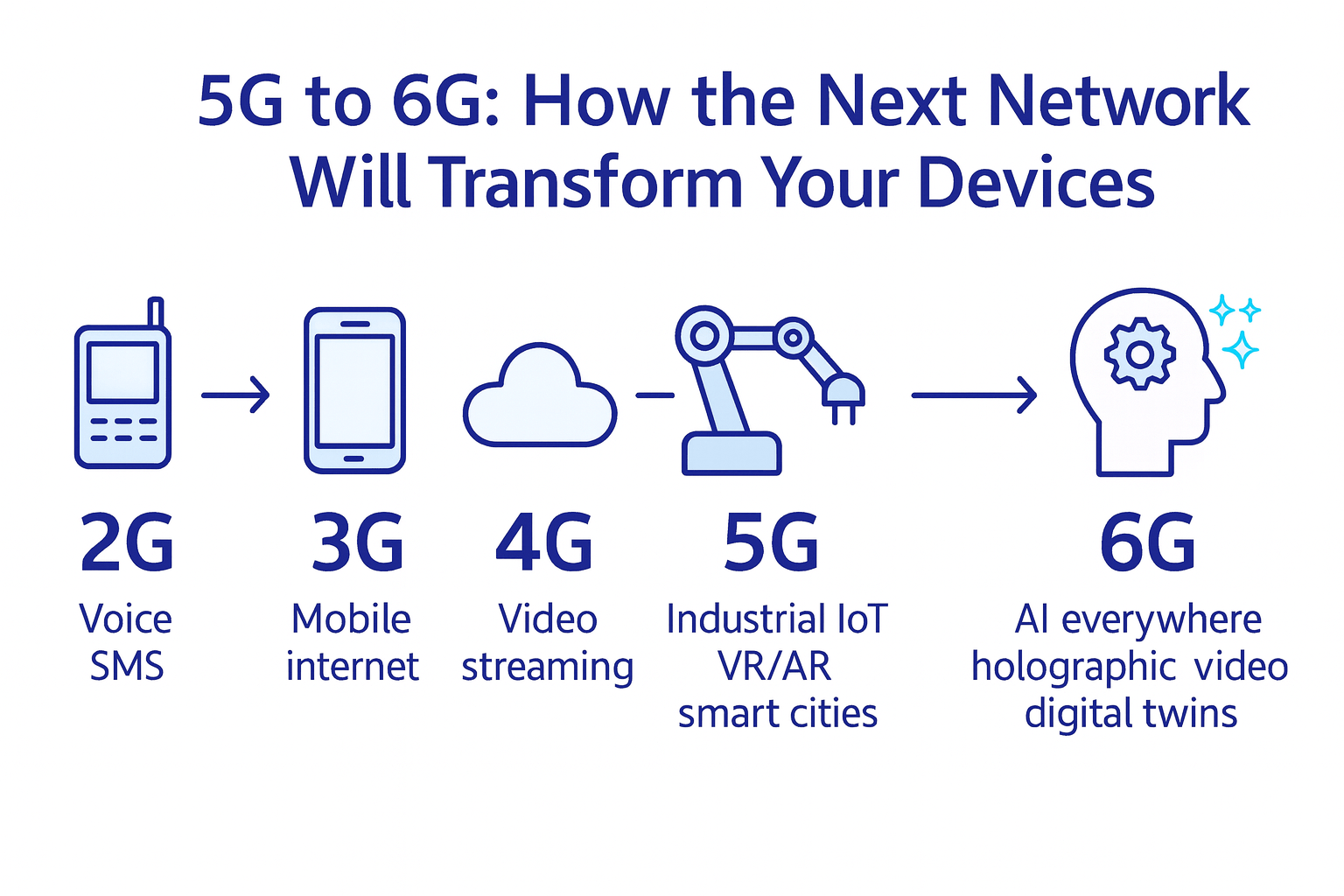
With every new generation of network technology, how we use it to communicate also changes. In the 2G and 3G eras, the focus was on connecting people through calls, texts, and simple mobile data.
The 5G era expanded to the internet of things and industrial automation. Now, the upcoming 6G generation will focus on connecting everything in even more innovative ways. With speeds measured in Tb/s and almost zero delay, 6G could make human productivity limitless.
In this article, we are going to explore how moving from 5G to 6G will reshape your devices and your daily life.
Table of Contents
5G in Simple Words (30 Seconds to Understand)
5G stands for the fifth generation of mobile networks. It is the one powering most new smartphones today. It was built to be much faster than 4G, handle more devices at the same time, and respond almost instantly when you tap, click, or stream.
The first significant change with 5G is speed. In ideal conditions, it can be many times faster than 4G. For example, a full HD movie can be downloaded in seconds instead of minutes.
The second change with the 5G network is latency. It’s the time it takes for data to travel. With 5G, this delay is so slight you won’t notice it. So, making video calls, gaming, and live streaming feel smoother than ever.
The third significant change with the 5G network is the capacity to connect far more devices at the same time without losing performance. Even in crowded places like stadiums or concerts, 5G can keep thousands of devices connected without slowing down.
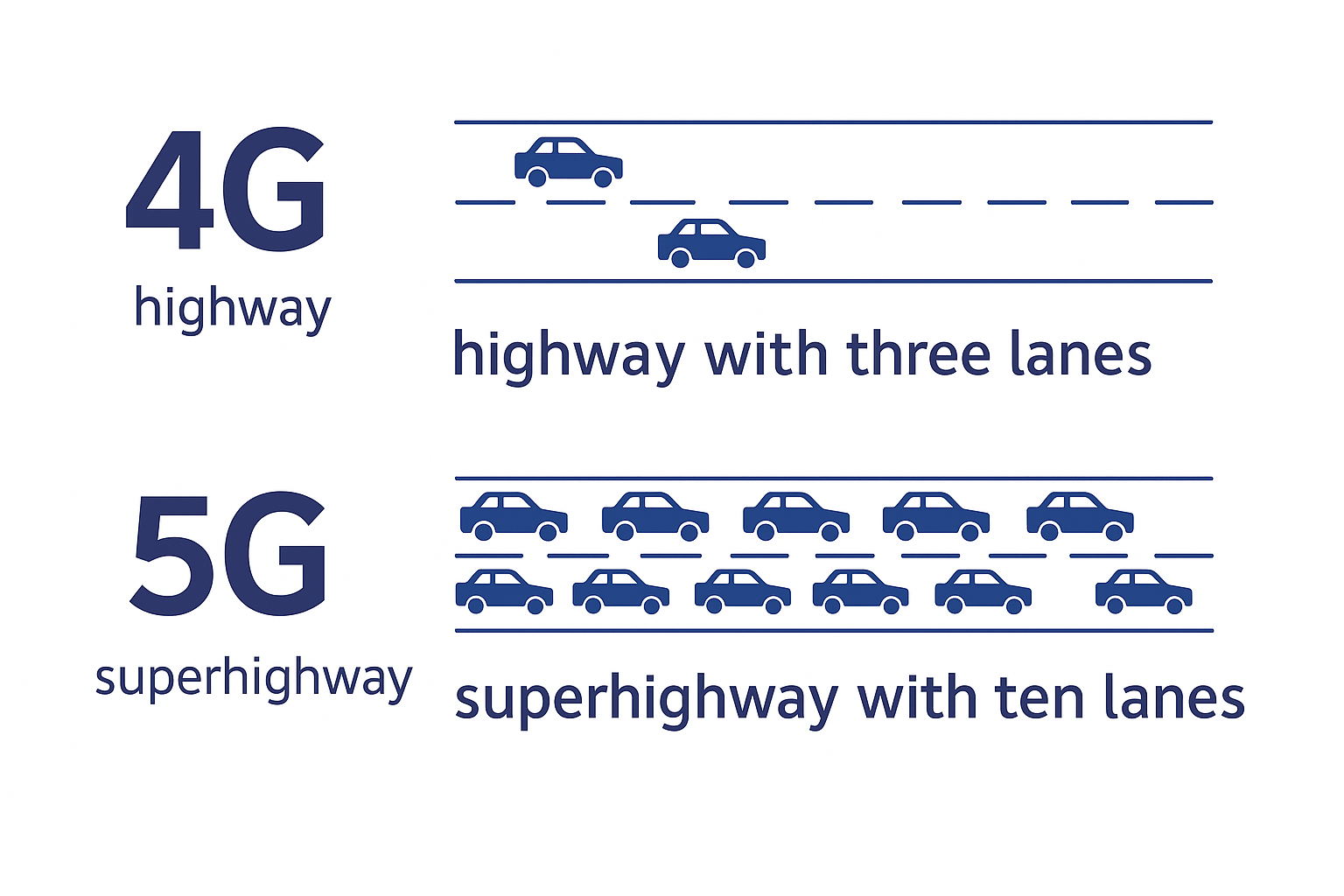
Think of a 5G network like this: if 4G is a highway with three lanes, 5G is a superhighway with ten lanes. More lanes mean more cars can travel quickly without traffic jams. That’s why 5G feels faster, smoother, and more reliable.
How 6G Will Change Your Devices
6G will make devices faster and smarter than anything we have used before. This next generation will link your phone, car, home, and healthcare devices in ways that feel effortless.
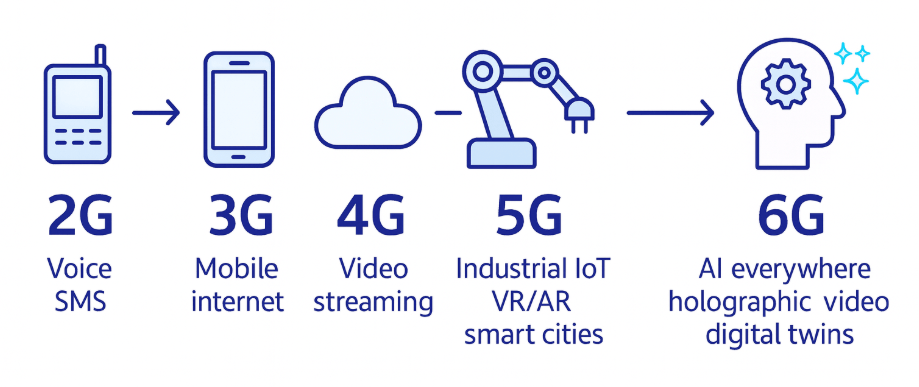
The speed and intelligence of 6G will let technology work quietly in the background, so every action feels instant. Here are some of the most common ways the 6G network could be used:
Mobile Phone or Tablet
With the 6G network, your phone or tablet could download a full HD movie in less than a second. The network will also manage power more efficiently, helping your battery last longer throughout the day.
This means you’ll be able to have more time streaming, gaming, and working without worrying about constant charging.
AR and VR Headsets
With 6G, AR and VR headsets will feel completely real, with no visible lag or motion blur. You could explore a museum on the other side of the world in real time, as if you were walking through it yourself.
Companies like Meta are already developing mixed reality experiences. These experiences can feel almost natural, immersive, and seamless.
In Cars
6G will let vehicles communicate instantly with each other and with road systems. A Tesla or Waymo could detect a hazard far ahead and adjust before you even notice. This instant coordination will help make roads safer and driving more efficient.
Healthcare Devices
Hospital-level care could reach your home through 6G-enabled medical technology. A Philips Healthcare robot might allow a surgeon to operate from thousands of miles away without delay.
Wearable devices could also track your health in real time. It will help alert your doctor before any symptoms appear.
Smart Homes
Homes will respond to you without a single command, thanks to 6G technology. Lights, appliances, heating, and security systems will work together instantly, adapting to your habits. You might not even notice the network itself, only the smooth and perfectly timed results.
5G vs 6G: The Big Differences
5G already feels fast, yet 6G will push wireless technology even further. While 5G delivers high speed, low latency, and connects billions of devices, 6G will bring advanced intelligence and real-time features like holographic communication.
Current 5G networks use frequencies up to 100 GHz, while 6G will move into the terahertz (THz) range. This shift will unlock massive bandwidth, enabling terabit-per-second speeds with near-instant response times.
As a result, device density will grow from millions to tens of millions per square kilometer. It can even allow entire cities to function as seamlessly connected systems.
Here is a comparison to show the main difference between 5G and 6G:
| 5G | 6G |
| Launch: 2019–2020 | Launch: ~2030 |
| Speed: Up to 10 Gbps | Speed: Up to 1 Tbps |
| Latency: ~1 ms | Latency: <0.1 ms |
| Frequency: Up to 100 GHz | Frequency: Up to 1 THz |
| Density: ~1M devices/km² | Density: Tens of millions devices/km² |
| AI: Partial optimization | AI: Fully AI-driven |
| Capabilities: IoT, VR/AR, industry | Capabilities: Holograms, smart sensing, digital twins |
Challenges of 6G (What Could Slow It Down)
While 6G promises incredible speed and intelligence, it also faces real challenges before becoming part of everyday life. The technology is still in development, and solving these hurdles will be the key to its success.
One of the most significant issues is the shorter range of terahertz (THz) signals. As these signals do not travel far, networks will need many more antennas and base stations to provide consistent coverage. This could be harder in rural or remote areas.
Another challenge is the higher energy use that comes with powering so many devices and towers. Groups like Greenpeace are calling for greener technology to make sure 6G does not increase environmental impact. This means using energy-efficient equipment and relying more on renewable power sources.
Privacy & data security are also significant concerns. The risk of cyberattacks grows with millions of devices connected in real time. Global research alliances like the Beyond 5G Promotion Consortium and the 6G-IA are already started working to build stronger protections for the next generation of networks.
Final Thoughts
6G will be about intelligence, not just speed. The next generation of wireless technology will connect devices faster and make them work together in more innovative and seamless ways. Every day life could feel more connected than ever, with technology quietly supporting our needs in the background.
By 2030, 6G may be as essential as the internet is today. We might look back and wonder how we ever managed without it. Major telecom companies and governments around the world are already investing heavily in research to develop 6G technology.
Written by Sadiul Alam Saadi






0 Comments